Money loan court: When fast track snails
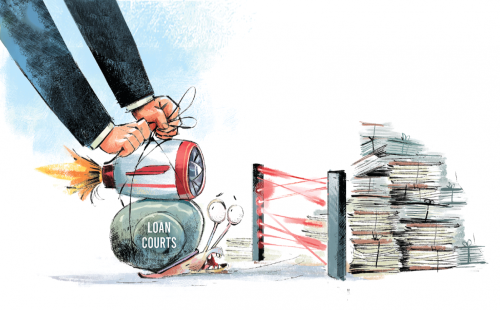
The 2003 Money Loan Court Act promised speedy recovery of
defaulted bank loans, requiring cases to be disposed of within 120 days. But
the very first lawsuit filed under the law tells a different story.
Filed by Janata Bank in early 2004 to recover
Tk18 crore from a firm called Green Tannery, the case has lingered for 22
years, endured 104 hearing dates, and still remains unresolved.
Ayub Hossain, the lawyer representing
Janata Bank, noted that the defendant took eight years just to submit a
response, and the case was adjourned 64 times over its first nine and a half
years. In 2014, the defendant challenged the proceedings before the High Court,
resulting in a six-month stay that effectively stretched into eight years.
While the trial finally resumed and the first witness testified in August 2022,
no money has been recovered to date.
This premier case starkly illustrates the
systemic crisis facing Bangladesh's loan recovery mechanism, which has failed
to keep pace with mounting defaults. Until May this year, 74,679 recovery suits
involving nearly Tk4 lakh crore in defaulted loans remained pending in 68 loan
courts across the country.
On average, each judge is handling more than
1,050 cases, while judges in Dhaka face workloads nearly ten times heavier.
With a disposal rate of less than 10% over the last couple of years, the case
backlog continues to grow annually.
Against this backdrop, the government is
considering measures to fast-track loan courts. In its Monetary Policy
Statement for July-December, released on 1 July, Bangladesh Bank outlined seven
measures to improve loan recovery, including a plan to make the Money Loan
Courts function as fast-track tribunals.
However, former Bangladesh Bank deputy governor
Muhammad A (Rumee) Ali observes that the special law's objective has largely
failed.
"Very few cases are resolved within 10
years," he said. "Even after a judgment is delivered, borrowers often
obtain stay orders from higher courts. In practice, courts frequently operate
without judges, face severe staffing shortages and have no effective time
limits for hearings. Cases drag on for years while new ones continue to pile
up."
Legal experts and bankers argue that while the
central bank's move is a step in the right direction, it requires appointing
more judges, establishing additional courts, and increasing resources. Even
then, rapid disposals will remain a far cry if core court procedures are not
made faster, more efficient, and strictly time-bound.
The scale of the backlog
Dhaka now has four Money Loan Courts.
As of 30 May, Dhaka's First Money Loan Court had
6,835 pending cases, with another 856 stayed by the High Court. It includes 123
cases that are more than 20 years old, 764 cases older than 10 years, and 2,348
cases pending for more than five years. These cases involve nearly Tk28,000
crore in defaulted loans.
In 2025, the court received 1,108 new cases but
disposed of only 96. It received 1,345 cases in 2024 and disposed of 108. The
court remained without a judge from February 2024 to May 2025.
The Second Money Loan Court has the largest
backlog, with 14,342 pending cases involving about Tk41,000 crore in defaulted
loans, including 306 cases older than 20 years.
The Third Court has 12,103 pending cases
involving around Tk32,000 crore, while the Fourth Court has 8,534 pending cases
involving approximately Tk31,000 crore.
Together, Dhaka's four courts are handling
41,814 cases involving nearly Tk1.32 lakh crore in defaulted loans – an average
of 10,553 cases per judge.
Why is the disposal rate so low?
According to Bangladesh Bank, Supreme Court and
money loan court statistics, as of 30 May, Bangladesh's 68 Money Loan Courts –
four in Dhaka, two in Chattogram and one in each district – received 14,208 new
cases in 2025 and resolved only 2,496. In 2024, 16,345 cases were filed and
1,606 were disposed of.
A Supreme Court source said 11 of the country's
68 Money Loan Courts have remained without judges for nearly a year,
effectively halting proceedings.
Outside Dhaka and Chattogram, Money Loan Court
judges also hear family disputes, money suits, declaration suits and other
civil cases, further reducing the time available for loan recovery cases.
Lawyers say this shared jurisdiction
significantly slows the disposal of default loan cases.
Bank and corporate law expert Barrister
Md Mostafizur Rahman (Nirjhor) told TBS that the main reason for
lengthy proceedings is the shortage of judges and court staff.
"Hearings are often delayed because judges
are unavailable," he said. "In many cases, defendants abscond or
leave the country, causing proceedings to remain stalled."
He also said banks themselves often contribute
to the problem through inadequate due diligence before approving loans.
"In many cases, mortgage documents are
incomplete or property valuations are inflated. When the collateral is
eventually auctioned, it fails to generate enough money to recover the loan,
reducing banks' incentives to pursue recovery aggressively," he added.
Mohammad Nurul Amin, chairman of Bangladesh
Krishi Bank, said that even after banks obtain favourable judgments,
borrowers frequently file writ petitions in higher courts, delaying enforcement
for years.
What would it take to create fast-track courts?
Constitutional law expert
Dr Shahdeen Malik said fast-track courts
are specialised tribunals designed to prioritise specific
categories of cases to ensure swift justice.
He said the government would need to formally
designate the courts through a gazette notification and amend existing laws to
shorten statutory deadlines.
The courts should be given exclusive
jurisdiction over loan recovery cases, he said, and the number of courts must
be increased.
"With each judge already handling more than
a thousand cases – and more than 10,000 cases per judge in Dhaka – speedy
disposal is impossible under the current structure," Malik said.
He estimated that at least 10 additional Money
Loan Courts are needed in Dhaka alone.
Malik also said the current government
allocation for the judiciary is insufficient to establish and operate
fast-track courts.
"Creating fast-track courts is essential,
but it will require genuine commitment from both the government and the banking
sector," he added.
New legal tools could help
Banking law expert Imran Ahmed Bhuiyan
recommended introducing rocket docket procedures, under which judges enforce
strict timelines for case management, as well as summary judgment and expedited
proceedings.
Where there is no genuine dispute over the
facts, courts should be able to issue judgments without conducting full trials,
enabling banks to recover loans much more quickly, he said.
He further suggested requiring borrowers to
deposit a portion of the outstanding loan before filing writ petitions against
Money Loan Court orders in higher courts, arguing that this would discourage
borrowers from using litigation simply to delay repayment.
Finally, he stressed that banks must improve
borrower screening and collateral valuation before approving loans, and that
politically motivated lending and political interference in loan recovery must
come to an end.