Terminated HSBC staff demand 120 months' salary, allege labour law violations
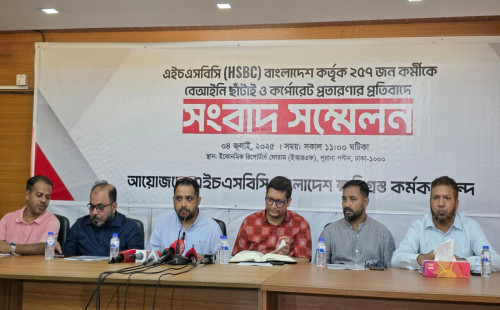
Terminated employees of HSBC Bangladesh today (4 July)
demanded compensation equivalent to 120 months' salary and alleged that the
bank violated labour laws and deprived them of legal benefits while shutting
down its retail banking operations.
The allegations were made at a
press conference organised by affected employees at the Economic Reporters'
Forum (ERF) auditorium in Dhaka.
Reading out a written statement,
former HSBC employee Alamgir Kabir said 257 officials lost their jobs when the
bank closed its retail banking division on 31 March 2026.
He said many of the affected employees had served the bank for between 15 and
25 years.
The employees claimed HSBC paid
compensation equivalent to a maximum of 15 months' salary, which they described
as discriminatory compared with compensation packages offered by the bank in
other countries.
They alleged that HSBC provided
compensation equivalent to 120 months' salary during a similar restructuring
process in India and 84 months' salary in Sri Lanka.
The employees further alleged that
the bank failed to follow labour laws during the redundancy process and
provided different information to Bangladesh Bank and to employees, depriving
staff of their legal rights and statutory benefits.
According to the written statement,
documents submitted to Bangladesh Bank referred to the affected staff as
"retrenched" employees, while letters issued to employees cited
Section 26 of the Labour Act relating to termination.
They claimed this distinction was
used to deny them retrenchment-related compensation and other legal benefits.
The employees also criticised HSBC
Bangladesh Chief Executive Officer Mahbubur Rahman, alleging that the decision
was implemented without discussions with affected staff and without proper
consideration of Bangladesh Bank's directives.
They further claimed that although
Bangladesh Bank instructed the bank to ensure the maximum possible benefits for
affected employees following their petition, HSBC later argued before the court
that the regulator's directive was not legally binding.
The employees alleged that HSBC
violated nine legal obligations, including failing to notify the Department of
Labour, not following the last-in-first-out (LIFO) principle, denying
retrenched employees priority in future recruitment, unlawfully deducting money
from provident fund and gratuity payments, violating labour laws in loan
adjustments, increasing home loan interest rates, withholding release letters,
compelling employees to sign documents waiving legal rights, and disregarding
conditions imposed by Bangladesh Bank.
They demanded cancellation of the
entire dismissal process, action against those responsible, payment of fair
severance packages and Workers' Profit Participation Fund (WPPF) benefits, and
the return of all deducted amounts from provident funds and other entitlements
with applicable interest and penalties.
The affected employees also called
on Bangladesh Bank, the Ministry of Labour and the Department of Labour to take
necessary action in accordance with the law.
Notably, HSBC announced their
decision to wind down its retail banking business in Bangladesh in a phased
manner last year. As part of the exit plan, the bank stopped onboarding new
retail customers and transitioned existing clients. Following that, employees
were terminated earlier this year.