Amid unchecked pollution, Savar's groundwater could become unusable in 10 years
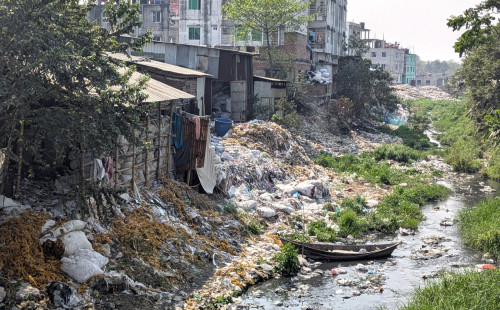
Along the bank of the Karnatali River, a
branch of the Dhaleswari cutting through Savar, a stretch of cropland lies
beside the highway. Across the fields, a narrow muddy drain carries industrial
wastewater toward the river. The water appears unnaturally blue, while the
whitish sludge around it is laden with toxic chemicals and microorganisms,
reportedly discharged from nearby textile factories before reaching farmland.
About half a kilometre southwest lies Karnapara, a densely
populated textile industrial hub and residential neighbourhood. Wastewater
flows into the only remaining 20-foot-wide Karnapara canal throughout the day —
a steady stream of blackish liquid mixed with industrial discharge.
Residents say the canal has remained clogged with
industrial effluents and household waste for nearly two decades, turning what
was once a functioning waterway into a stagnant channel of pollution.
The rivers surrounding Savar — including the Bongshi, Turag, Karnatali, and
Dhaleswari — have long suffered from pollution as industrial clusters have
expanded along their banks. Landfills and dumping sites have also grown into
mound-like hills of waste.
As a result, environmental pressures have intensified,
placing natural resources under increasing strain and gradually rendering them
hazardous to human use.
Savar, a rapidly urbanising and industrialising area within
Dhaka district, now faces a mounting threat of groundwater contamination.
According to the Water Supply and Sewerage Authority (WASA), about 85–86% of
the area's potable water comes from groundwater, making the region heavily
dependent on underground aquifers.
Experts warn this groundwater is
particularly vulnerable due to its proximity to industrial zones, waste dumping
sites, and poorly managed water systems. A study titled "Groundwater
vulnerability assessment in Savar upazila of Dhaka district, Bangladesh — A
GIS-based DRASTIC modeling" indicates that around 21% of Savar falls under
high vulnerability to contamination, while about 45% is moderately vulnerable.
Home to nearly 23 lakh people, Savar relies largely on
groundwater extracted through deep tube wells and submersible pumps. Residents
often describe the water as "so clear it reflects like a mirror," and
most households consume it directly for drinking and cooking without
filtration. Geologically, the region lies within the Madhupur Tract above the
productive Dupi Tila aquifer, which has long provided a reliable source of
clean groundwater.
"The aquifer enabled the development of a reliable groundwater-based water
supply in this area," said Mashura Shammi, associate professor at the
Department of Environmental Sciences at Jahangirnagar University.
She warns that if pollution continues unchecked, the
groundwater beneath Savar could become heavily contaminated within the next
10–15 years. With most surface water already polluted by industrial chemicals,
heavy metals, and other contaminants, groundwater remains the region's primary
source of drinking water.
Contamination
occurs where pollution exists
Savar's industrial growth has helped turn Bangladesh's
garments sector into a multi-billion-dollar success story. Yet as exports
expanded, environmental pressure on land and water resources intensified.
Experts say groundwater contamination is largely driven by unregulated
industrial activity and poor waste management.
"The common cause of groundwater contamination is its
connection with polluted surface water and industrial waste dumped in low-lying
areas," said Kazi Matin Uddin Ahmed, professor of geology at the
University of Dhaka. "In many cases, contaminants from the surface seep
through the soil and eventually reach groundwater."
Pollutants pass through the vadose zone — the layer between
the ground surface and the water table — before entering the aquifer. In some
areas, a natural red clay layer near the surface slows contaminant movement,
but beneath rivers, this layer is often thin or absent, allowing pollutants to
reach groundwater more quickly.
Besides conventional contaminants such as
arsenic, iron, and manganese, experts warn of a growing presence of emerging
pollutants that do not occur naturally. "Water quality may appear
acceptable under standard measurements, but the real concern lies with emerging
pollutants such as heavy metals, microorganisms, and chemicals like PFAS,"
said Professor Ahmed. These "forever chemicals" persist in the environment
and do not break down easily.
Landfill sites are another major pathway of contamination.
Rainwater percolates through accumulated waste, dissolving
heavy metals and organic substances to produce leachate — a dark liquid that
seeps into soil and groundwater. Across Savar's industrial zones — including
Hemayetpur, Ashulia, and Zirabo — such pollution has become common. Groundwater
tests have already detected industrial pollutants such as chromium, lead, and
manganese, indicating growing human influence on water quality.
An area defined
by unplanned development
Wastewater from the Savar Tannery Industrial Estate (STIE)
flows into the Dhaleswari River, while solid waste from the estate is dumped in
a nearby yard, raising concerns about both surface and groundwater pollution.
The central effluent treatment plant (CETP), built to process tannery waste,
remains only partially operational despite more than Tk500 crore spent over 21
years.
According to the Bangladesh Tanners Association, 163
tanneries are registered at STIE, with 130 operational. During peak months,
these factories generate around 45,000 cubic metres of wastewater daily, while
the CETP can treat only 25,000 cubic metres.
"Contamination can spread beyond the immediate
discharge zone and potentially affect groundwater," said Shammi. Over
time, contaminants from disposed solid waste, particularly leather scraps, can
leach into surrounding soil, increasing chromium pollution risk.
Contamination can spread beyond the immediate discharge zone and
potentially affect groundwater.
Beyond tanneries, the textile and dyeing industries are
also major contributors. Around 400 industries linked to ready-made garments
operate in the Savar–Ashulia belt. "Almost all of these industries are
located along rivers and canals," Shammi said, noting that many factories
either lack proper waste management systems or fail to operate their ETPs
effectively.
Landfills add another major source of groundwater
pollution. Rainwater passing through piles of municipal waste produces leachate
containing dissolved solids, ammonia, organic matter, and heavy metals.
One of the largest sites is the Aminbazar Landfill, the
main disposal facility for Dhaka North City Corporation. Spread across roughly
52–55 acres, it receives 3,000–3,500 tonnes of solid waste daily, with piles
rising nearly 90 feet. Residents within a 10-kilometre radius, including villages
like Konda and Baliarpur, may face significant contamination risks. Smaller
informal dumping grounds have also emerged across Savar, especially along
rivers, canals, and highways.
Growing
environmental and health concerns
Groundwater contamination carries serious environmental and
public health costs, as the aquifers serve as the main water source for
domestic, agricultural, and industrial use. "One of the major
environmental impacts is the gradual degradation of soil quality," said
Professor Ahmed. Contaminated groundwater is used for irrigation, allowing
heavy metals and toxic chemicals to accumulate in soils, reducing fertility and
crop productivity.
Research around STIE found high concentrations of heavy
metals such as chromium, cadmium, lead, and copper in surrounding soils, with
chromium levels up to 3,220 mg/kg — 32 times higher than recommended safety
limits. Polluted groundwater also discharges into nearby rivers, canals, and
wetlands, degrading aquatic ecosystems and threatening biodiversity. Industrial
pollution introduces heavy metals that accumulate in plants, fish, and other
organisms, moving up the food chain.
Public health risks are equally
concerning. A study examining drinking water in Savar restaurants found 17 out
of 20 samples contaminated with coliform bacteria, while Escherichia coli was
detected in 35% of samples, indicating faecal contamination.
Microbial pollution can spread water-borne diseases,
including diarrhoea, cholera, typhoid, and dysentery. Long-term exposure to
contaminated water may also cause liver damage, kidney dysfunction,
neurological disorders, and increased cancer risks.
The way ahead
Rapid industrialisation and urban expansion have
dramatically reshaped Savar, replacing natural spaces and water bodies with
factories, settlements, and infrastructure.
"Over the years, industrialisation has expanded settlements
and infrastructure in Savar, replacing many natural spaces and water
bodies," said Farhadur Reza, associate professor at the Department of
Urban and Regional Planning at Jahangirnagar University. His research mapping
land transformation between 1995 and 2024 shows urbanisation in Savar increased
by around 274%.
Over the years, industrialisation has expanded settlements and
infrastructure in Savar, replacing many natural spaces and water bodies.
Addressing groundwater contamination requires tackling two major drivers:
industrial pollution and weak waste management systems.
Farhadur Reza, Associate Professor, Department of
Urban and Regional Planning, Jahangirnagar University
Addressing groundwater contamination requires tackling two
major drivers: industrial pollution and weak waste management. Stronger
enforcement of environmental regulations is essential. Industries are required
to install and operate effluent treatment plants before releasing wastewater,
but many either lack such facilities or keep them non-functional.
"Industries that fail to treat their waste properly should not be allowed
to operate. Factory licences should be suspended until proper treatment systems
are installed," Reza said.
Improving municipal waste management is another critical
step. Waste disposal in Savar largely involves collecting household garbage and
dumping it in open spaces. Effective management should include collection,
segregation, processing, and safe disposal. Biodegradable waste could be
converted into compost, while recyclables like plastic, paper, glass, and metal
should go to recycling industries.
Proper landfill design is also essential, including
protective liners to prevent contaminated liquids from seeping into soil.
"In Bangladesh, most landfill sites do not follow these standard
practices. Waste is simply dumped until it forms a mound," Reza said.
Beyond technical solutions, strict land-use planning is
necessary. Industrial facilities should not be located near residential areas
or sensitive water bodies. "If proper land-use planning existed, many of
these industries would not have been allowed to operate in those
locations," he said.