'It was then 2.15 am...March 26 in 1971'
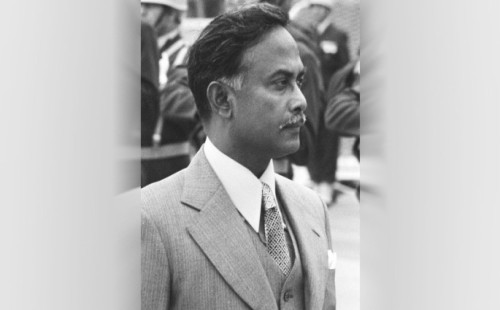
Shaheed President Ziaur Rahman revolted
against the Pakistani military junta at 2:15 am on 26 March, 1971, mobilising
Bengali troops under his command at the port city of Chattogram.
26 March 1971 is
Bangladesh's Independence Day, while in a reflective article Zia later
described the day as "etched in the Bangalee's heart in blood
letters".
Ziaur Rahman, a major
in the Pakistan army, revolted against the Pakistani military junta at that
very hour from the battalion of the 8th East Bengal Regiment where he was
posted as the second in command.
Coinciding with the first anniversary of the country's independence on 26 March
1972, he got an article titled "Birth of a Nation" published in the
now defunct Dainik Bangla, when he was the deputy army chief having the
elevated rank of major general as a senior 1971 veteran.
Coinciding with the first anniversary of the country’s
independence on March 26, 1972, Ziaur Rahman had an article titled “Birth of a
Nation” published.
Weekly Bicitra, a
sister concern of the same newspaper, reprinted the piece on the same day in
1974.
"The time was
very precious. I called the (Bengali) officers, JCOs (junior commissioned
officers) and the jawans (ordinary soldiers) . . . I directed them to appear in
armed struggle. They unanimously accepted the order willingly," Zia wrote.
Ziaur Rahman then
moved the troops to the Kalurghat area on the outskirts of the port city where
Bengali radio employees had by then set up the makeshift clandestine Swadhin
Bangla Betar Kendra from where he proclaimed the Independence of Bangladesh.
In that reflective article, Zia recounted the Bengalis' cultural repression and
political marginalisation under Pakistani rule, particularly the prolonged
military regimes, as he spent the earlier part of his army career.
"After the
creation of Pakistan when (Pakistan's founder) Mr Jinnah declared in historic
Dhaka city that 'Urdu and only Urdu' would be the state language of Pakistan,
in my opinion from that day Bengali nationalism was sewed in the hearts of
Bengalis," he wrote.
Zia added,
"The founder of Pakistan himself had sewed the seed of destruction of the
unnatural country on that very day on this field of Dhaka." He said the
actions of the Pakistani junta made armed resistance imperative as well as
inevitable.
The article
recounted the chronological political developments — the 1952 Language
Movement, the 1954 general elections, the military rule under Ayub Khan, the
1965 Pak-India War, the nationalist movements of the 1960s and the subsequent
1970 general elections — as major events that shaped his thinking.
Zia particularly
noted Pakistani rulers' deliberate attempts to obstruct East Pakistan's
development, their despicable attitude towards Bengalis and their efforts to
suppress the nationalist uprising as factors that led Bengalis towards their
eventual Liberation War.
The 1969 mass
uprising and the Agartala conspiracy case accusing Sheikh Mujibur Rahman as the
prime suspect reinforced the demand for independence.
"The fate of
the case (resulting in unconditional release of Sheikh Mujib) forged the unity
of Bengali soldiers, sailors and airmen . . . in solidarity with the Bengali
civilian population," Zia wrote.
Awami League's
landslide victory in the 1970 elections was a major setback for the Pakistani
rulers, but their deliberate delay and conspiracies to halt transfer of power
heated up the political situation, leading to the start of the nationwide
Non-Cooperation Movement in March 1971.
Zia wrote that the
Pakistani army began to secretly strengthen military preparedness for the
crackdown and, in that backdrop, Sheikh Mujib delivered his landmark 7 March
address.
"The historic
7 March speech of Sheikh Mujib at Race Course Maidan appeared to us as the
'green signal'. We gave our plan its final shape . . . then appeared the black
night appeared between 25 and 26 March," the article read.
Zia wrote that on
the night of 25 March, Pakistani forces carried out a brutal massacre of
unarmed Bengalis in Dhaka and other major cities, making the horrific hours a
pivotal moment for Bengalis to take a "right decision" for waging the
Liberation War.
He wrote that at
1am of that black night, his commanding officer ordered him to report to
Pakistani General Ansari at Chittagong Port in a navy truck, where he awaited
him possibly like an ambush predator "perhaps to receive me forever (for
killing)".
He recalled that
on the way to the port, Bengali Major Khalequzzaman Chowdhury intercepted him
and informed him about the launch of the Pakistani crackdown, prompting him to
return to his battalion where he saw Bengali soldiers had by then detained all
Pakistani officers in a room.
Zia wrote that
upon reaching his office he tried to communicate with Bengali Lt Colonel MR
Chowdhury and Major Rafiqul Islam but could not reach them. After failing to
reach the military officers, he called the telephone operator of the civilian
service.
"I requested
him to inform the deputy commissioner, police superintendent, commissioner, DIG
(police) and Awami League leaders that the 8th Battalion of the East Bengal
Regiment had revolted and they would fight for the independence of the
country," he wrote.
Zia also wrote
that initially he tried to contact all civilian officers by phone but could not
reach any, forcing him to approach the telephone operator, who agreed to carry
out his request.
He then turned to
the Bengali soldiers of the unit and delivered a speech addressing them.
"They knew
everything. (Yet) I briefly told them everything," Zia wrote, describing
the moment of revolt.
The article,
available on the internet, contained over 3,650 words, while he said a
journalist encouraged him to write the piece ahead of the first anniversary of
independence, although Zia was initially skeptical about his own writing
skills.
"I am a
soldier. Writing is a God-gifted talent and soldiers do not naturally possess
that rare artistic ability. But that historic moment was so emotional that I
too had to write something. I had to pick up the pen," he wrote.