Metro or monorail? Experts say Chattogram needs neither
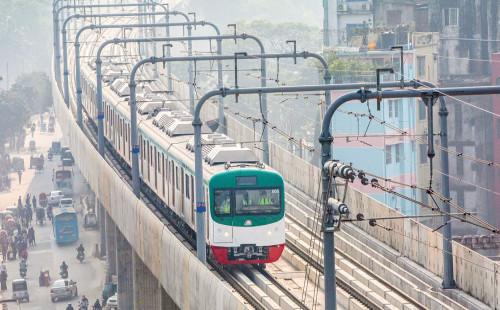
Chattogram's push for a mass rapid transit system has
sparked a debate between metro rail and monorail, but transport experts argue
that neither should be the city's priority, saying authorities are bypassing
cheaper and more practical solutions to congestion and public transport
shortcomings.
The debate has emerged as the Dhaka
Transport Coordination Authority (DTCA) prepares a transport masterplan for the
Chattogram Metropolitan Area. While the government is leaning towards metro
rail, Chattogram City Corporation Mayor Dr Shahadat Hossain is actively
promoting a monorail project.
According to DTCA, the
"Transport Master Plan and Preliminary Feasibility Study for Urban Mass
Rapid Transit Construction of Chattogram Metropolitan Area" aims to
formulate a comprehensive transport strategy, reduce congestion and assess the
feasibility of an environmentally friendly urban rail system.
The project began in January 2023 and was initially scheduled for completion in
June 2025. Its deadline has since been extended to December 2026.
The estimated cost is Tk70.63
crore, including Tk13.63 crore from the government and Tk57 crore in assistance
from the Korea International Cooperation Agency (KOICA). Financial progress
stands at 45% and physical progress at nearly 50%, although officials fear the
remaining work may not be completed within the revised timeline.
A high-level DTCA team visited key
roads in Chattogram from 5 to 7 June. Following the visit, DTCA Executive
Director and Additional Secretary Dr Md Mashiur Rahman said the final
masterplan and recommendations would be submitted by December 2026 after
analysing passenger demand and traffic conditions.
He said technical assessments are
underway to determine the most suitable mode of transport. Metro rail is being
considered for high-demand corridors, light rail transit (LRT) for
medium-demand routes and monorail for lower-demand areas.
However, Mayor Shahadat is pursuing
a different path.
During a meeting with the DTCA
delegation, he said the city corporation had already submitted a specific
monorail proposal and held discussions with relevant ministries. The mayor
hopes to complete feasibility studies by December and begin implementation work
next year.
Last June, the Chattogram City
Corporation entered into memorandums of understanding with two foreign firms,
Orascom Construction and The Arab Contractors, for the development of a
monorail network.
According to the city corporation,
the proposed system would cover three routes spanning 54.5km at an estimated
cost of Tk25,000 crore. The entire investment would come from foreign
investors, while the corporation would only have to provide logistical support
and land.
Yet even as metro and monorail
advocates present competing visions, experts are questioning the premise
itself.
Mir Mohammad Kamrul Hasan, project director
and traffic engineer at DTCA, said studies indicate metro rail is the only
option capable of meeting Chattogram's growing transport demand through 2042.
"Monorail can carry only about
one-third of the passengers of metro rail. It cannot meet Chattogram's
long-term demand. However, the monorail may be considered as a feeder service
to the metro rail," he told TBS.
Chattogram Development Authority
chairman engineer Md Nurul Karim stressed the need for a careful feasibility
assessment, saying any transport project must be economically viable while
preserving the city's unique environment.
But transport planners and
engineers remain unconvinced.
Engineer Subhash Barua, road
transport expert and vice-president of the Planned Chattogram Forum, questioned
both DTCA's capacity and the rationale behind pursuing another mega project.
He pointed to the troubled Bus
Rapid Transit (BRT) project between Dhaka and Gazipur and argued that
authorities have failed to implement even basic traffic reforms in the capital.
Barua described metro rail and
monorail proposals as just politically driven ambitions detached from ground
realities.
He said Chattogram's major
corridors, particularly from Bahaddarhat to Patenga, are already crowded with
flyovers and elevated motorways, leaving little room for additional rail
infrastructure.
He also criticised planning
processes that overlook informal transport users and local travel patterns,
particularly women's reliance on rickshaws.
According to Barua, decentralising
development and focusing on upazila growth centres would be more effective than
pouring investments into costly urban megaprojects.
"Instead of spending thousands
of crores on the wrong solutions, improving traffic management and public
transport can solve 80% of Chattogram's transport problems," he said.
Engineer Delwar Majumder, former
president of the Institution of Engineers, Bangladesh (IEB), Chattogram Centre,
echoed similar concerns.
He argued that authorities appear
to decide on projects first and then conduct feasibility studies to justify
them, rather than determining whether the projects are actually needed.
Majumder referenced the Karnaphuli
Tunnel and the Elevated Motorway as instances where design concerns and
economic viability were overlooked.
"The tunnel is not attracting
the expected traffic. Its operating costs and foreign debt obligations are now
creating significant pressure on the national economy," he said.
He added that authorities should
first exhaust low-cost options such as traffic management reforms, lane
discipline, pedestrian facilities and improved bus services before moving to
expensive rail-based systems.
"Metro rail and monorail
should be considered only in the final stages of transport planning. However,
in Chattogram, authorities are bypassing fundamental steps and opting directly
for the most costly solutions. Consequently, the current approach is heading in
the wrong direction," he stated.
While experts agree that a metro
rail or monorail can be built technically, they insist the central question
remains whether such projects would be economically sustainable, widely used
and genuinely beneficial for the people of Chattogram.