Promise flickers, problems persist
With
galleries buzzing despite torrential rain, the Sher-e-Bangla National Cricket
Stadium in Mirpur seemed to regain its soul -- fuelled by hopes of a T20I
series win for Bangladesh.
Instead,
the rain-hit third and final T20I against New Zealand last Saturday followed a
familiar, frustrating script. Litton Das and Co. were beaten by an
inexperienced touring side, leaving the three-match series drawn 1-1 after
Bangladesh had won the opener, and the second game was washed out in
Chattogram.
For a New
Zealand team missing around 15 frontline players due to commitments in the
Indian Premier League and Pakistan Super League, the result raised questions.
Yet Bangladesh Cricket Board (BCB) chief selector Habibul Bashar did not term
it as a “terrible outcome”.
Bangladesh’s
T20 side has recently hinted at a shift in identity -- moving away from their
traditionally cautious approach towards a more proactive brand of cricket.
However, that evolution remains largely untested at the highest level, especially
after missing out on the most recent T20 World Cup.
This
series marked the start of preparations for the 2028 edition, but the
performances exposed lingering concerns. The top-order fragility resurfaced as
a major issue, while the middle order had a fifty percent success rate.
In the
first match, chasing 182, early wickets left Bangladesh on the brink. A
spirited counterattack from Tawhid Hridoy, Shamim Hossain, and Parvez Hossain
delivered a convincing win, showcasing the potential of the middle order.
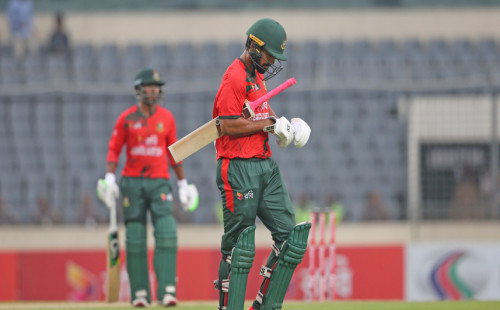
But in
Mirpur, the same problems persisted. The top order faltered again, and this
time the lower order followed suit, sealing a comprehensive defeat.
“Our first
match was very organised, but we lost our way in the final game,” Bashar told
The Daily Star, urging caution in judging a series heavily affected by rain.
“We are trying new things, so it’s not right to be overly critical based on
these two matches. I liked the look of this team -- the gelling, spirit, and
teamwork are good.”
With
experienced pacers Mustafizur Rahman and Taskin Ahmed rested, the series
offered opportunities to new faces. Ripon Mondol featured in both matches but
went wicketless, while Abdul Gaffar Saqlain did not get a game. Shoriful Islam
stood out as the lone bright spot, earning the Most Valuable Player of the
Series award.
“The
weather didn’t help us,” Bashar noted. “There is a long way to go. It’s a new
squad, especially in the bowling department. If these players contribute going
forward, it will strengthen the team. Our two main bowlers will return, which
will make us stronger.”
Bashar
also dismissed concerns over New Zealand fielding a second-string side, noting
that experimentation is a natural phase for any team in the lead-up to a World
Cup.
Bangladesh,
too, are committed to that path, but only with the existing group as it
appears. Further changes, including possible rotation in the batting order, are
on the cards. Vice-captain Saif Hassan remains under scrutiny, having failed to
register a fifty in his last eight T20Is while maintaining a modest strike rate
of 104.5.
While
Bashar emphasised giving “everyone a chance” to build competition within the
squad, the experimentation so far has largely been limited to the existing
group.
That
raises a pressing question: will persistence with this core be enough, or is it
time for a broader rethink before the countdown to the 2028 World Cup gathers
pace?