Japanese economic zone taking shape with $353m from 12 firms, more in pipeline
On a single factory floor in Araihazar, around 200 workers – most of them women – sit in a structured production line, placing individual hair strands, sewing, and assembling frames. The finished products, high-quality customised wigs, are shipped to Japan and Singapore.
The scene on the factory floor is modest in scale but significant in signal. BSEZ, also known as the Japanese economic zone, is no longer just a plan on paper.
At least 12 local and foreign companies have secured land in the zone, with combined proposed investments of around $353.4 million. Three are already in production, while around 30 more firms from various countries are in the pipeline.
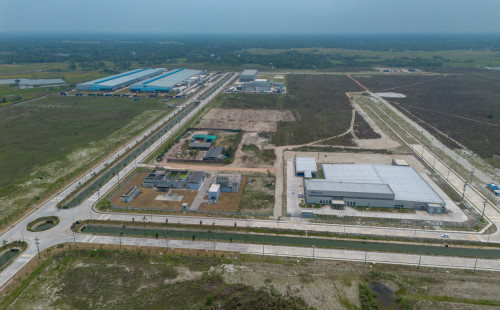
Active development work was observed during a visit to the site on 9 April. In areas where production has begun, well-constructed internal roads are in place. In plots yet to be built on, wide roads and drainage systems have already been laid.
The Bangladesh Economic Zones Authority (Beza) has handed over around 230 acres to BSEZ so far, with another 220 acres due for transfer within the year.
"The entire area has already been filled and prepared for industrial use," a Beza official said.
Investors span a broad range of industries – home appliances, textile chemicals, FMCG, food processing, hair accessories, and packaging – suggesting BSEZ is developing as a diversified industrial hub rather than a single-sector cluster.
Who are already operating
Singer Bangladesh Limited, acquired by Turkey-based Koç Group in 2019, leads in both scale and investment. Allocated 33.4 acres, the company has proposed an investment of $78 million, of which $56.3 million has already been realised.
Starting operations from 2024, it operates in the home appliances segment and represents the zone's largest single operational presence.
Japan-based Lion Kallol Limited has begun production in the FMCG sector on 8.4 acres, with $7.6 million invested out of a planned $19.4 million. Its initial product lineup includes Mama Lemon Liquid Dish Wash and Systema Toothbrush, with plans to gradually expand its household and personal care range. It began factory operations in March this year.
Artnature rounds out the trio, having realised $9 million of a planned $20 million investment on 4.9 acres. Beyond its production floor, the factory also houses research and development operations, with staff working on customised product design. Artnature began its operations in November 2025.
"We are currently operating as a 100% export-oriented company," said factory General Manager Md Tanvir Rahman. "We plan to expand into raw fiber processing in the future."
He added that while a domestic market for ready-made wigs exists in Bangladesh, Artnature targets the customised segment, an area not yet well established locally.
Who are next
Germany's Rudolf Bangladesh Limited and Japan's Nicca Bangladesh are entering the textile chemicals sector. Rudolf has invested $2.5 million of a planned $20 million, while Nicca has committed $5 million of a planned $7 million.
In food processing, UK-Bangladesh joint venture Pladis ACI Bangladesh Limited is preparing to begin construction on 7.2 acres, with $3 million invested out of a proposed $27 million.
Chinese investors are making a particularly significant push. BSN (Bangladesh) Packaging Company is planning an $80 million project on 9.3 acres, the largest single proposed investment in the zone, with $6.5 million already committed. Leaders Label Material (Bangladesh) has invested $3 million of a planned $25 million.
Sweden's Nilorn Bangladesh (U-2) Limited. has committed $15 million on 2.47 acres. Japan's Bengal Iris Takumi., specialising in textile accessories, has invested $2 million of a planned $7 million. A local Bangladeshi company has secured 5 acres, planning a $25 million investment.
The infrastructure question
For manufacturing investors, infrastructure readiness is often the difference between a signed agreement and an operational factory. On this front, BSEZ is making progress though not everything is in place yet.
Electricity supply is connected to the national grid, and a dedicated 230-kilovolt substation is under development to improve power quality and reliability. Water supply and treatment facilities are fully operational. Natural gas, critical for energy-intensive industries, is the remaining piece.
BSEZ Managing Director Chiharu Tagawa said a government-installed gas supply station has been prepared and that supply is expected to reach the zone by mid-2026.
"Once supply becomes available, it will significantly improve efficiency for energy-intensive industries," he added. Until then, the gas connection remains a limiting factor and one that investors in heavy manufacturing will be watching closely.
Post-election momentum
Tagawa said investor interest picked up significantly following Bangladesh's national election, with inquiries now coming from more than 30 companies.
"We cannot count exactly, but 30 companies from different countries – including US, China, Japan, and Korea – are now interested in BSEZ. Day by day, it is increasing," he said.
Key areas of interest include home appliances, motorcycle parts, batteries, FMCG, and consumer goods. Tagawa attributed the interest to Bangladesh's large domestic market, export potential, and the operational advantages of a dedicated economic zone.
Bangladesh Investment Development Authority (Bida) and Beza Executive Chairman Ashik Chowdhury echoed that assessment, noting that large-scale commitments tend to generate further interest.
"Such large-scale investments create a positive signalling effect. We already have several major investment proposals in the pipeline, which are under discussion. We expect significant progress in investment inflows this year," he said.
The bigger picture
BSEZ has created around 3,000 jobs to date. The long-term target is to accommodate 90-100 companies across the full 1,000 acres within the next six to seven years, with total investment expected to reach $1-2 billion.
Around 268 acres remain available for allocation. Beza Deputy Secretary Mohammad Zakaria Mithu said the focus is now on converting interest into implementation.
The ground-level reality at BSEZ today – operational factories, roads laid through empty plots, gas infrastructure nearly ready – reflects a zone that has moved past its early stage but still has most of its story left to write.
Whether the 30-plus companies in the pipeline translate into the next wave of operational companies will determine whether BSEZ becomes the industrial landmark both governments envisioned.