The BNP govt pursuing ‘US First’ policy

The BNP
government is pursuing an “America First” policy while paying lip service to its
“Bangladesh First” motto, said economist Anu Muhammad yesterday.
He
questioned the government’s motives for implementing the former interim
government’s agreements with the US “without any parliamentary debate”.
Anu
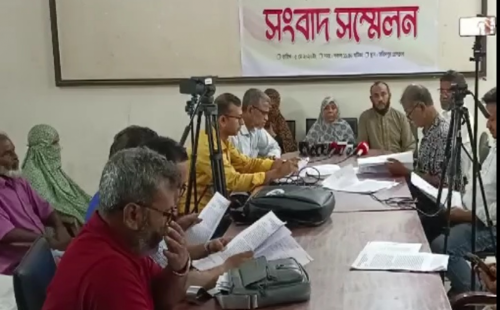
Muhammad, also a leader of the Democratic Rights Committee, made the remarks at
a discussion titled “Two and a Half Months of the BNP Government: Review,
Concerns and Demands” at the Dhaka Reporters Unity.
During the
event, which he chaired, the committee placed a 13-point demand.
“Tarique
Rahman says ‘Bangladesh First’, but the agreements signed with the US show that
the government is operating on an ‘America First’ policy,” he said.
He alleged
that deals contrary to national interests -- such as importing LNG, purchasing
aircraft, and granting port access -- were made with the US, bypassing state
entities like Petrobangla and Biman.
“Instead
of punishing those involved, like Khalilur Rahman, the current elected
government has rewarded them with greater responsibilities,” Anu Muhammad
observed.
Criticising
the government’s energy policies, the economist said that rather than boosting
national capacity, the government is amending Production Sharing Contracts
(PSCs) to “favour” foreign companies under the influence of corporate
lobbyists.
Recalling
the historic 2006 Phulbari agreement, he noted that despite a pact to ban
open-pit mining, the government is again leaning towards coal extraction. He
demanded 100 percent state ownership in oil and gas exploration.
To
radically change the education and healthcare sectors, Anu Muhammad proposed a
simple, cost-free solution.
“If it is
made mandatory for the children of the president, prime minister, ministers,
MPs, and government officials to study in public educational institutions and
receive treatment at government hospitals, these two sectors will see massive
positive changes overnight. We don’t need foreign loans for this,” he added.
Speaking
at the event, writer and researcher Altaf Parvez expressed disappointment over
the government’s handling of international relations, particularly with India.
He said despite improved bilateral ties, key issues like border killings and
the renewal of the Ganges Water Treaty remain unresolved.
He alleged
that although the BNP pledged to implement the July Charter in its manifesto,
it later declined to join the constitutional reform council, effectively
stalling the process.
Raising
concerns over recent economic decisions, Altaf criticised an ordinance allowing
banks to return to their original shareholders, including individuals accused
of corruption and money laundering.
Dhaka
University Professor Samina Luthfa said campuses have increasingly become
centres of political control rather than academic excellence.
“Even when
one student organisation’s influence declined, another quickly replaced it,
perpetuating the cycle of political occupation,” she observed. This environment
fostered organised violence that later became popularly known as “mob rule”,
she added.
Despite
repeated calls over the past 21 months, no education reform commission has been
formed, Samina also said.
Lawyers
Jyotirmoy Barua and Manjur Al Matin and DU Assistant Professor Moshahida
Sultana Ritu also addressed the event.
During the
event, the committee placed a 13-point demand.
Committee
member Sajib Tanvir and Democratic Students Council president Sayedul Haque
Nishan read out a concept paper outlining the demands.
The
demands include speedy trials for those responsible for the July killings, mob
violence, murders, vandalism, and arson; implementing necessary democratic
reforms across all sectors as pledged; taking immediate measures to stop
attacks on religious worship places, shrines, archaeological sites,
institutions, and homes; bringing the perpetrators to justice; taking necessary
steps to check the price hike of daily essentials; announcing a national
minimum wage; forming commissions to ensure a farmer-friendly agricultural
system; establishing a uniform education system; initiating reforms to
establish healthcare as a constitutional right; ensuring completely free
medical services at public hospitals; and announcing a roadmap for the
withdrawal of military rule in the Chittagong Hill Tracts to foster a
democratic environment; ensuring equal rights for women regarding inherited
property and equal pay for equal work; forming a specialised cell to prevent
human trafficking and the oppression of expatriates; publishing all
international agreements signed with foreign nations and blocs; and taking
effective steps to cancel treaties that go against public interests.