RMG exporters demand lower source tax

Garment
exporters yesterday urged the government to cut the source tax from 1 percent
to between 0.5 and 0.65 percent, citing ongoing difficulties caused by domestic
challenges and external pressures.
They also
proposed keeping the reduced rate in place for the next five years.
In
addition, they called for exemption from the 10 percent income tax on export
incentive receipts, saying that export incentives have already been reduced as
part of preparations for Bangladesh’s graduation from the least developed
countries (LDC) group.
The
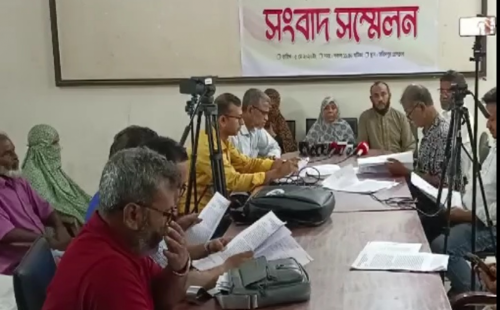
Bangladesh Garment Manufacturers and Exporters Association (BGMEA) and the
Bangladesh Knitwear Manufacturers and Exporters Association (BKMEA) made these
proposals in their budget recommendations for fiscal year 2026-27 (FY27), which
were submitted to the National Board of Revenue (NBR) yesterday.
Both
associations proposed setting the corporate tax rate for subcontracting
factories at 12 percent instead of the current 25 to 30 percent, arguing that
it should be aligned with existing policies where green factories pay 10
percent and non-green factories pay 12 percent.
They also
said subcontracting factories, which place work orders with other factories,
currently pay a 5 percent source tax on contract payments and demanded that it
be reduced to 1 percent in the upcoming budget.
In
addition, they proposed fixing the bond licence fee at Tk10,000 for three
years, along with relaxed rules for sub-contracting and bond licence locking.
They also
recommended exempting VAT and import duties on the import of man-made fibre and
non-cotton yarn, saying this is necessary to expand production using man-made
fibres and increase global market share.
Globally,
around 75 percent of garments are made from man-made fibres, while in
Bangladesh, over 70 percent of exports are cotton-based and only around 30
percent come from man-made fibres, meaning the country is missing significant
opportunities.
They added
that while cotton imports are already duty-free, similar tariff-free access
should be extended to man-made fibre and yarn to stay competitive.
RMG UNDER
PRESSURE AS EXPORTS FALL, COSTS RISE
The BGMEA,
in its proposal, said the garment sector is facing an unprecedented set of
challenges both at home and abroad, including global recession, geopolitical
instability and tariff wars that have slowed export growth.
Internal issues
such as rising costs of doing business, weak ease of doing business, and
structural weaknesses are also affecting competitiveness.
Recent
export data shows garment exports fell by 3.73 percent in July-February of FY26
compared to the same period of the previous fiscal year, with earnings
continuously declining since August 2025.
As a
result, factories are operating below full capacity, increasing fixed costs and
overall production expenses.
New work
orders have also slowed, with Bangladesh Bank data showing that back-to-back
letters of credit (LC) openings for raw material imports fell by 6.79 percent
in dollar terms during July-January of FY26.
Lower
export orders, combined with reciprocal US tariffs and higher Chinese exports
to Europe at competitive prices, have reduced export prices, with the average
unit price of garments falling by 1.76 percent in July-February of FY26.
In the
first seven months of FY26, imports of capital machinery dropped by 37.87
percent in the textile sector and 12.44 percent in the garment sector,
continuing a negative trend from the previous fiscal year.
This
reflects declining capacity and a weak investment climate, raising concerns
about the sector’s future.
The data
shows that the country’s main export-earning sector, the RMG industry, is going
through a critical period, with around 400 garment factories closing over the
past three years while many others remain financially weak.
At
present, lending interest rates have risen to 12 to 15 percent, while energy
costs have increased sharply amid ongoing shortages. Gas prices rose by 286
percent between 2017 and 2023, and electricity tariffs increased by 33 percent
over the past five years.