Sydney reopens beach under heavy patrols after shark attack
Highlights:
- Authorities increase patrols, deploy drones as Coogee beach
reopens
- New South Wales government mulls new tech-driven safety measures
- Australia has seen a spate of shark attacks, some fatal, in recent
months
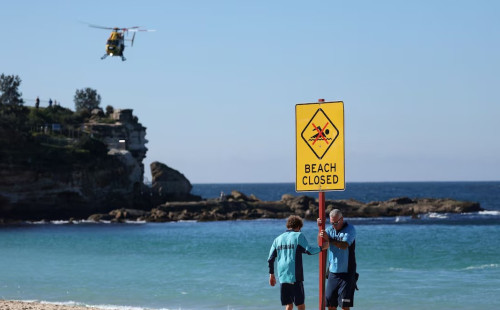
Sydney's Coogee Beach reopened on Monday under the watchful
eyes of lifeguards and jet ski patrols, after a shark attack over the weekend
left a woman critically injured and prompted a safety review at Australia's
popular shorelines.
The 35-year-old victim was swimming
about 30 metres (100 feet) from the shore on Saturday morning when she was
bitten by a three-to-four-metre-long shark, sustaining serious injuries to her
arms and lower left leg. She remains in hospital in stable condition.
Local authorities urged swimmers to be cautious.
"Our lifeguards will continue
jet ski patrols throughout the day, and Surf Life Saving NSW is operating a
shark-spotting drone at Coogee Beach," Randwick City Council said in a
statement.
Coogee, south of iconic Bondi
Beach, is symbolic of Sydney's coastal lifestyle. The beaches, which lie east
of the city, are famous for their golden sands and dramatic coastal cliffs and
draw millions of tourists from around the world every year, making water safety
a high-stakes priority for the authorities.
"I wouldn't even dip my toe in
at the minute," said local resident Ryan Brady.
"I used to do a few lengths
across the beach but I'd always have in the back of my mind is there sharks
around but after, after the weekend, no. It's kind of a nail in the coffin for
me."
Saturday's attack was the latest in
a series of shark encounters off Australian beaches. The week before, a man
died after being attacked by a shark while fishing off the coast of Western
Australia.
Last month, a 39-year-old man died
after being attacked while fishing on Queensland's Great Barrier Reef. Ten days
before that, a 38-year-old was fatally mauled off an island near Perth in
Western Australia.
Dozens of beaches along Australia's
east coast were closed in January after four shark attacks in two days.
While shark encounters remain
statistically rare, a Reuters analysis of data from the Australian Shark
Incident Database shows a gradual rise in encounters, with the country
averaging nearly 29 incidents per year over the last decade, up from an average
of roughly 16 per year in the 2000s.
"We have seen more shark bites
recently but that's probably more to do with population increase," said
Leonardo Guida, shark scientist at the Australian Marine Conservation Society.
Climate change was also a factor,
he added, with warmer waters prompting people to go to the beach more often,
and also changing sharks' movements.
"Climate is changing how our
ocean works and sharks are just one aspect of it," Guida added.
Shark cull debate
The attack has forced a regulatory
review of aerial surveillance. While emergency drones were deployed on Monday,
Coogee normally faces strict flight restrictions because it sits directly
beneath the flight path for Sydney's airport.
New South Wales Agriculture
Minister Tara Moriarty said on Monday that nothing was off the table as the
state considered safety measures.
Some experts said Saturday's attack
was by a white shark, a protected species under environmental laws.
However, the attack has again led
some to suggest a cull, a highly contentious issue.
"It's so wrong that we don't
cull sharks after attacks," former conservative Prime Minister Tony Abbott
said in a video posted on his Facebook page.
Australia already culls sharks as
part of its shark meshing programme and additional culling was unlikely to
produce a measurable difference, said Emeritus Professor Rob Harcourt, from the
Sydney Institute for Marine Science at Macquarie University.
"Other safety measures,
including drones (and) smart drum lines, and their help with understanding and
then predicting when foraging sharks are likely to be present, have already
shown to be of high efficacy," he said.