CSE aims to launch country's first commodity exchange this year
The Chittagong Stock Exchange (CSE) is aiming to launch
Bangladesh's first commodity exchange this year, with its Managing Director M
Shaifur Rahman Mazumdar, saying the
bourse could go live within three to four months once it receives the remaining
regulatory approvals.
Speaking at a post-budget press
conference held at the CSE conference hall today (14 June), Shafiqur said the
exchange's technological infrastructure is fully ready and efforts to build
market awareness are in their final stages.
"We could have launched the
commodity exchange a year earlier had the government's thinking and the
regulatory authorities' approach been aligned with our roadmap," he said.
Shafiqur added that the government's latest budget has explicitly mentioned the
establishment of a commodity exchange alongside other infrastructure development
initiatives, removing a major policy hurdle.
"We have already placed our
proposals before the regulator. If the new regulatory authority approves the
brokers and products we have proposed, we will be able to go live within three
to four months," he said.
"We are hopeful that since
government policy is now aligned with our programme, the commodity exchange
will be launched within this year."
Commodity derivatives to be introduced first
Shafiqur clarified that the planned
exchange would initially operate as a commodity derivatives platform rather
than a spot market involving physical delivery of goods.
"There is a misconception that
a commodity exchange means physically delivering commodities. In reality, there
are two types of exchanges – spot exchanges, where physical delivery takes
place, and derivatives exchanges, where futures and options contracts are
traded," he said.
According to him, CSE plans to
start by allowing the trading of commodity futures contracts, enabling
investors, hedgers and participants across the commodity value chain to manage
risks through a transparent marketplace.
Under futures trading, participants
enter contracts by depositing margins, while the exchange's technology platform
ensures real-time adjustment and risk management.
"Our objective is to provide a
platform for price discovery, hedging and risk management," Shafiqur said.
What is commodity exchange
According to Shafiqur, a commodity
exchange is a regulated marketplace where commodities or contracts linked to
commodities are traded, much like shares are traded on a stock exchange.
These commodities can include
precious metals such as gold and silver, agricultural products such as rice and
wheat, and imported goods such as crude palm oil.
Commodity exchanges generally operate
either as spot markets, where physical delivery of goods takes place, or as
derivatives markets, where futures and options contracts are traded without the
immediate exchange of the underlying commodity.
By enabling participants to
discover fair prices, hedge against price volatility and manage risks,
commodity exchanges help create more transparent and efficient markets.
They can also benefit producers,
including farmers, by allowing them to secure prices for their products in
advance, reducing uncertainty and distress sales.
Gold, silver and crude palm oil are proposed as initial
products
CSE has proposed launching the
platform with gold, silver and crude palm oil futures, considering them
relatively straightforward products with internationally recognised pricing
benchmarks.
"Gold and silver prices are
globally available and well understood. Crude palm oil is an important product
for Bangladesh. If we can successfully launch the platform with these products,
we can gradually bring other essential commodities into the market," he
said.
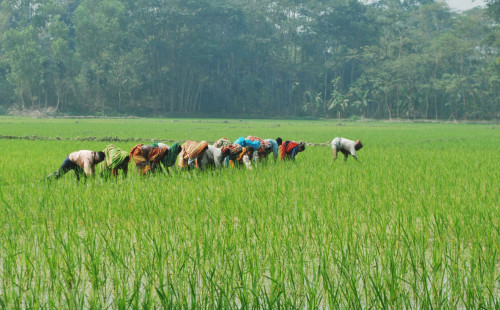
Shafiqur said agricultural products
could eventually be incorporated into the exchange, creating opportunities for
producers to secure prices for their goods months before harvest.
"If agricultural products are
introduced, producers will be able to trade their future output in advance.
Farmers would face less pressure to sell immediately after harvest and could
better manage price risks," he said.
He added that any product
introduced on the exchange would require approval from the regulator, ensuring
appropriate checks and balances, particularly for sensitive commodities.
Farmers could benefit through guaranteed pricing
Shafiqur argued that commodity
futures markets could strengthen farmers' bargaining power by allowing them to
lock in prices before bringing products to market.
"If farmers can secure prices
in advance, the pressure they currently face at the time of sale will reduce
significantly," he said.
He cited rice as one of the
agricultural products CSE may consider in the future if the initial phase
proves successful.
Lessons from India's experience
Director Major (Retd) Emdadul Islam
pointed to India's commodity exchange experience as an example of how organised
markets can improve quality standards and pricing.
Referring to India's cotton sector,
he said commodity exchanges helped organise producers, establish scientific
storage facilities and ensure both quality assurance and fair prices.
"Farmers became assured of
prices and quality, while users gained confidence that they would receive
products of a certain standard," he said.
Emdadul noted that Bangladesh often
experiences severe price volatility and post-harvest losses in agricultural products
due to inadequate storage and fragmented markets.
"Many times farmers are forced
to throw away products or sell at distress prices because they have no
bargaining power," he said.
Emdadul added that a
well-functioning commodity exchange could improve price transparency and reduce
inefficiencies in markets ranging from agricultural goods to imported
essentials such as edible oils.
"We are operating with an
imperfect market serving 180 million people. A perfect market requires proper
price discovery and advance certainty. Commodity exchanges can contribute to
that process with the support of regulators and the government," he said.